Free marriage biodata formats in English, Gujarati and Jain styles, with a step-by-step guide on what to include, photo tips and mistakes to avoid.
Quick answer: A marriage biodata is a one- or two-page profile that a family shares with prospective matches. A good one has seven parts: a recent photo, personal details, community and horoscope details (if your family follows them), education and work, family background, a short "about me", and what you are looking for in a partner. Keep it honest, specific and free of private ID numbers, and share it as a PDF.
For most Indian families, the biodata is
the first thing the other side sees, long before any phone call or meeting. It
gets forwarded on WhatsApp, printed for elders, and read and re-read by
parents, siblings and sometimes a family astrologer. A clear, truthful biodata
gets the right replies. A vague or inflated one gets the wrong ones, or none at
all.
Our Relationship Managers at Rishtadekhoo
read and verify biodatas every day for Gujarati, Jain and NRI families. This
guide sets out what works: what to include, how to write each part, three free
templates you can copy, and the mistakes that cost families good matches.
What is a marriage biodata?
A marriage biodata (also written "bio
data for marriage" or "matrimonial biodata") is a short document
introducing a person who is looking for a life partner, along with their
family. It is the standard first step in an arranged marriage in India. One
family shares it, and the other decides from it whether to take the
conversation further.
It is not a job resume. A resume sells your
skills to an employer. A biodata helps two families judge compatibility:
values, background, lifestyle, location and expectations, as well as education
and career. That is why it includes things a resume never would, such as family
details, native place and, for many families, horoscope details.
In practice, a biodata is used in three
ways:
•
Family to family: parents send it to
relatives, friends and community contacts, usually on WhatsApp.
•
Through a marriage bureau: a
Relationship Manager uses it to shortlist and introduce matches. At
Rishtadekhoo we also verify the details in it before it is shared.
•
For a first decision: elders, siblings
and sometimes an astrologer read it before agreeing to a call or meeting. It
must make sense to all of them.
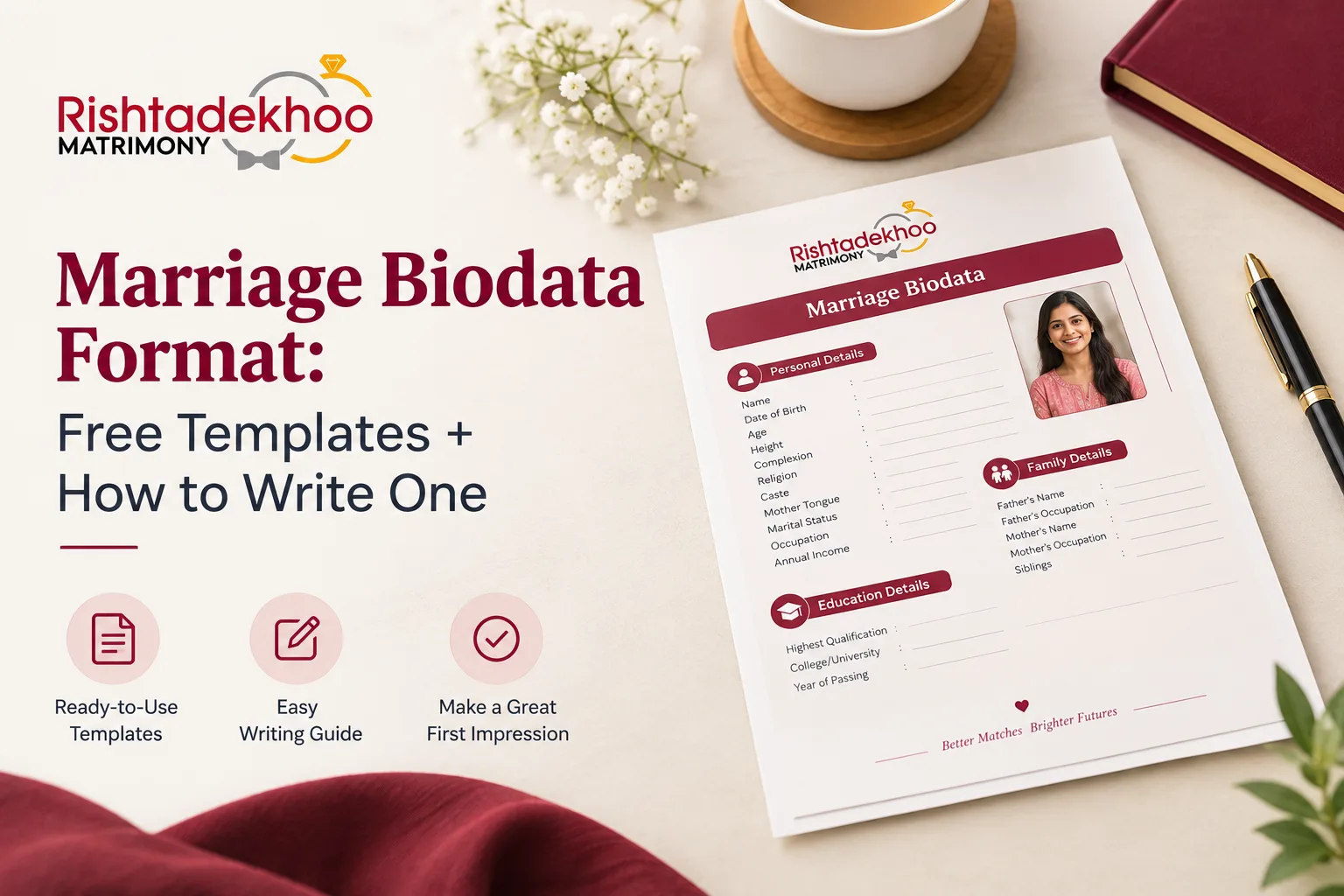
What to include in a marriage biodata
Every strong biodata covers the same seven
sections, in roughly this order. The order matters: families scan the top half
first and decide in seconds whether to read on.
|
Section |
What to write |
Example |
|
1. Photo |
One recent, clear, natural photo; a
second full-length photo is optional |
Head-and-shoulders, plain background,
taken in the last 6 months |
|
2. Personal details |
Full name, date of birth, height, place
you live now, marital status |
Priya Shah · 12 March 1997 · 5'4" ·
Ahmedabad · Never married |
|
3. Religion and community |
Religion, community, sub-community; gotra
if your family follows it |
Hindu · Gujarati · Audichya Brahmin ·
Gotra: Bharadwaj |
|
4. Horoscope details (optional) |
Time and place of birth, rashi,
nakshatra, manglik status |
Born 6:40 am, Rajkot · Rashi: Kanya ·
Non-manglik |
|
5. Education and work |
Highest degree and institute, current
role and employer, work location; income as a range, if you choose to share
it |
MBA, Nirma University · Senior Analyst, a
Big Four firm · Ahmedabad |
|
6. Family details |
Parents' names and occupations, siblings
and their status, family type, native place, and mosal (maternal family) for
Gujarati families |
Father: retired bank manager · Mother:
homemaker · 1 elder brother, married, in Pune · Native: Bhavnagar |
|
7. About me and partner preferences |
3–5 lines about your personality, values
and routine; 3–5 lines about what matters to you in a partner |
See the step-by-step guide below |
|
Contact |
Name and number of the person handling
enquiries (usually a parent), and an email address |
Contact: Mr. Rajesh Shah (father) · 98XXX
XXXXX |
The examples above are illustrative, not
real people.
Three fields cause the most hesitation:
•
Income: optional. If you include it,
give a range ("₹12–15 lakh a year") rather than an exact figure, and
make sure it matches what you can document. Our team verifies job and business
claims, and so will a careful family.
•
Horoscope details: include them only if
your family or the families you are approaching use kundali matching. If you
include them, be exact about the birth time. A wrong time changes the chart,
and matches are rejected on it.
•
Complexion and weight: leave them out.
They add nothing a photo doesn't show, and many families now see them as
outdated. Height is the only physical detail families consistently ask for.
How to write a marriage biodata, step by step
Set aside an hour, and write it together
with the person it is for. Biodatas written only by parents often miss what the
person actually wants. Those written only by the person sometimes leave out
family details that elders expect.
1.
Collect the facts first. Gather exact
birth details, degree names, employer, siblings' details and native place.
Check the birth time against the birth certificate or the family's janmakshar.
2.
Choose the format and language. English
works for most families. A bilingual English–Gujarati version helps when elders
in the other family will read it. Use one template from the next section and
keep it to 1–2 pages.
3.
Fill in the factual sections. Personal,
community, education, work and family details are facts, so write them plainly.
No adjectives are needed here.
4.
Write "About me" in your own voice. Aim for 3–5 sentences on how you spend your time, what you value
and how you see family life. Specific beats generic. "I cook dal-dhokli
for the family every Sunday and run 5 km three mornings a week" tells a
family far more than "I am simple, honest and family-oriented," which
nearly every biodata says.
5.
Write partner preferences as priorities, not a checklist. Name the 2–3 things that truly matter, such as values, diet, city
or willingness to relocate. Be open on the rest. A long list of demands narrows
the field and reads as inflexible.
6.
Add the photo. Use one recent, well-lit
photo. Guidance is below.
7.
Proofread with someone else. Check
spellings of names, degrees and places, and make sure dates and ages agree with
each other. One typo in a name is the most common error we correct.
8.
Export as a PDF and name the file properly, for example Priya-Shah-Biodata.pdf. Then share it only with families you are seriously considering.
Tip
from our Relationship Managers: before sending, ask
yourself whether a stranger reading it would know three real things about you
that set you apart. If the answer is no, rewrite the "About me".
Free marriage biodata templates
Copy any template below into Word or Google
Docs and replace the brackets, or download the ready-made versions. Each is
designed to fit on one page with a photo.
Download:
Classic biodata (Word) · Classic (PDF) · Gujarati–English (Word) · Jain (Word)
Template 1: Classic marriage biodata (English)
This works for any community and for both boys and girls.

Template 2: Gujarati–English biodata
Gujarati families usually expect two extra details: mosal (the mother's family and their native place) and mul vatan (the family's native village or town). Elders often place a family through these before anything else. Bilingual headings make the biodata easy for both generations to read.

Template 3: Jain marriage biodata
Jain families match closely on sect and food practice, so a Jain biodata should state these clearly instead of leaving them to a phone call.

For NRI families: four lines to add
If the person lives abroad or plans to
move, families on both sides will want these answers up front:
•
Country and city of residence, and since
when
•
Residency or visa status: citizen,
permanent resident or work visa
•
Plans: settling abroad, returning to
India, or open
•
Availability to meet: when the person is
next in India, and whether video calls are welcome before then
Marriage biodata for a girl vs a boy: what changes
The format is the same. What families look
for first is often different, so put extra care into these fields:
|
|
Biodata for a girl |
Biodata for a boy |
|
Families often read first |
Education, family background, values,
location |
Profession, stability of work, family,
location |
|
Worth stating clearly |
Career plans after marriage; openness to
relocating |
Where he is settled, and whether the
family lives jointly |
|
Common gap |
"About me" written by parents,
not her |
Vague job title ("in business")
with no detail |
|
Contact person |
Usually a parent; avoid listing her
personal mobile in widely shared copies |
Parent or the boy himself |
Whichever it is, the strongest biodatas
answer the other family's next question before they have to ask it.
Photo guidance
The photo is usually the first thing anyone
looks at. It should simply show what you look like today.
•
Recent: taken within the last 6 months,
with your current hairstyle, glasses and so on.
•
Clear and well lit: daylight facing a
window works better than flash. Use a plain background.
•
Natural: no beauty filters or heavy
editing. A first meeting that starts with "you look different" starts
badly.
•
Appropriate dress: smart-casual or
simple traditional wear. Bridal-style outfits and party photos send the wrong
signal.
•
One main photo: add at most one
full-length photo. Group photos make the reader guess who you are.
Mistakes we see most often when verifying biodatas
Before we introduce any profile, our team
checks identity, family background and job or business details. That work shows
the same mistakes again and again:
1.
Rounding up. A job title one level
higher, an income at the top of a range, or a degree listed before it is
complete. These come out in the first conversation, and trust is hard to
rebuild after that.
2.
An old or heavily edited photo. It is
the fastest way to turn a promising first meeting into an awkward one.
3.
A generic "About me".
"Simple, honest, God-fearing, family-oriented" describes almost
everyone, so it tells the other family nothing.
4.
A wish-list for partner preferences. Ten
non-negotiables narrow the matches to a handful. Three clear priorities work
far better.
5.
Too long. Three or four pages of
extended family detail get skimmed. One to two pages get read.
6.
No clear contact person. If an
interested family can't tell whom to call, or the number is out of date, the
match is lost.
7.
Inconsistent details. The age doesn't
match the date of birth, or the city differs between sections. It looks
careless, or worse, like something is being hidden.
What never to put in a biodata
A biodata is forwarded far beyond the
people you send it to. Treat it as public, and leave out anything that could be
misused:
•
ID numbers: Aadhaar, PAN, passport or
any government ID number. Share these only with a verification service you trust,
never in the biodata itself.
•
Full home address: the city and area are
enough.
•
Salary slips, bank details or property documents. These belong to a much later stage, if at all.
•
Personal mobile numbers of young women
in copies shared on groups. Use a parent's number instead.
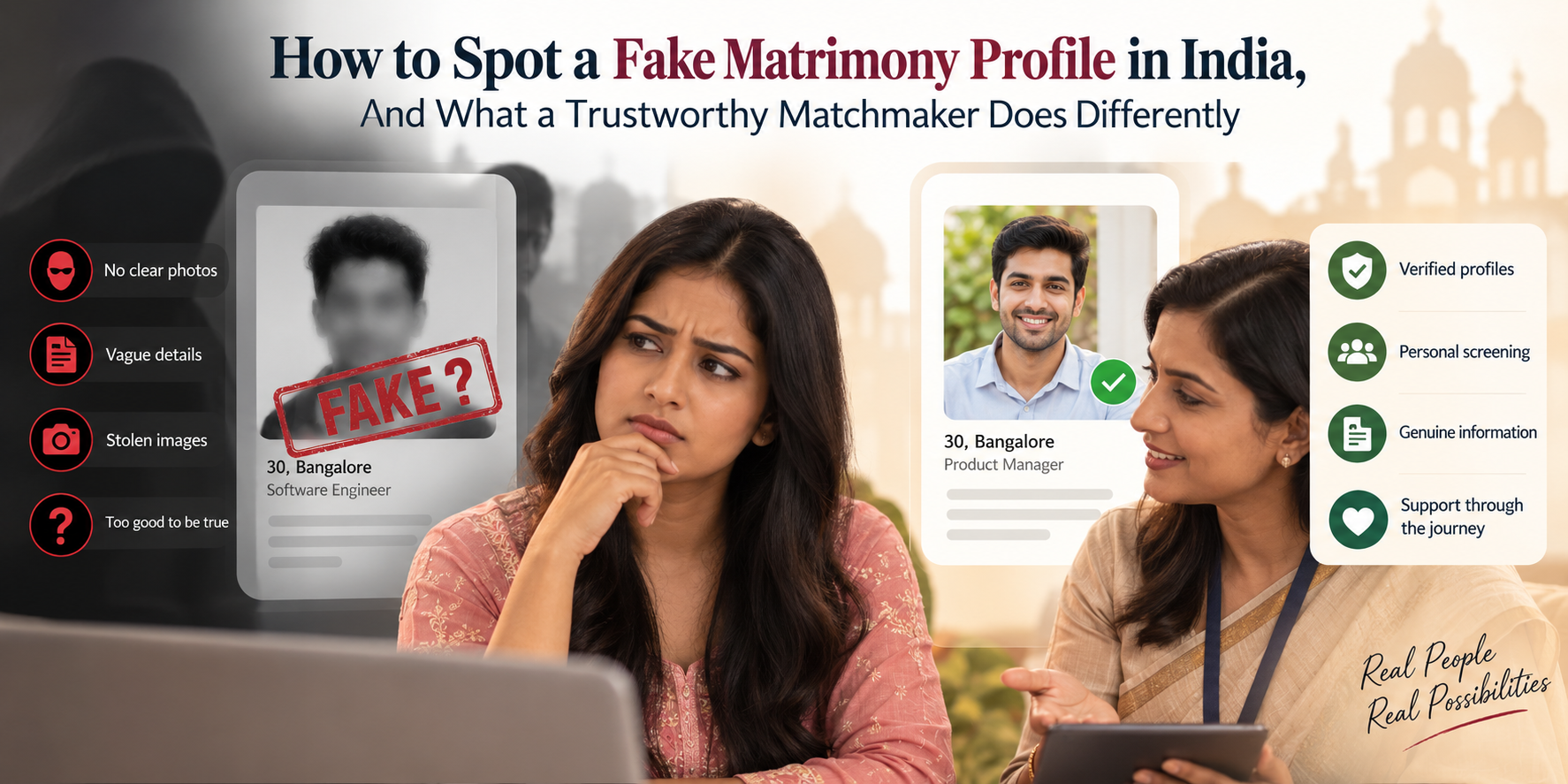
If a "match" asks for money, ID
copies or documents early on, treat it as a warning sign. We cover this in more
detail in Howto Spot a Fake Matrimony Profile in India.
Word, PDF or image: how to format and share it
Write it in Word or Google Docs, and share
it as a PDF.
|
Format |
Use it for |
Why |
|
Word / Google Docs |
Writing and updating |
Easy to edit when something changes |
|
PDF |
Sharing with families and bureaus |
Looks the same on every phone, prints
cleanly, can't be edited by accident |
|
Image (JPG) |
Avoid, except a single preview |
Text becomes hard to read when zoomed,
and details get cropped |
Formatting that reads well on a phone,
where most biodatas are opened:
•
One or two A4 pages, with the photo in
the top-right or top-centre.
•
One clean font at 11–12 pt, with bold
section headings. Skip decorative borders and religious graphics that crowd the
page; a small symbol at the top is fine if your family prefers it.
•
File size under 1 MB, so it opens
quickly on WhatsApp.
•
A clear file name: Firstname-Lastname-Biodata.pdf, not final_new_2.pdf.
•
A date in the footer ("Updated
October 2026"), so families know they have the current version.
Frequently Asked Questions
How long should a marriage biodata be?
One to two A4 pages. One page is enough for most people. Use a second page only for horoscope details or a longer family section. Families usually read biodatas on a phone, so anything longer gets skimmed rather than read.
What is the difference between a biodata and a resume?
A resume presents your skills to an employer. A marriage biodata presents you and your family to another family. It covers education and career, but also family background, community, lifestyle, values and partner preferences, plus horoscope details if the families use kundali matching.
Should I mention my salary in a marriage biodata?
It's optional. If you include it, give an annual range rather than an exact figure, and only one you can back up. Many families prefer to discuss income at the first meeting. A reliable marriage bureau will verify job and business details either way.
Are horoscope details necessary in a biodata?
Only if your family, or the families you are approaching, use kundali matching. If you include them, give the exact time and place of birth, rashi, nakshatra and manglik status. An inaccurate birth time changes the chart, so check it against official records first.
Can I make a marriage biodata in Gujarati?
Yes. A bilingual Gujarati–English biodata works well for Gujarati families: elders read the Gujarati headings and younger relatives read the English. Include mul vatan (native place) and mosal (maternal family), which Gujarati elders usually ask about first. Template 2 above is ready to copy.
How do I write a biodata for a second marriage?
Use the same format, and state your marital status honestly as divorced or widowed, with children if any. You don't need to explain the past in the biodata. A single calm line such as "Divorced in 2022, no children" is enough, and the rest can be discussed when families meet.
Do I need a biodata if I register with a marriage bureau?
Yes, it helps. At Rishtadekhoo, your Relationship Manager uses your biodata to shortlist matches and verifies its details before sharing it, and only with your consent. If you don't have one, we help you prepare it during the free consultation.
Need help with your biodata?
A good biodata opens the door, and the
right introductions do the rest. At Rishtadekhoo, a dedicated Relationship
Manager reviews your biodata, verifies every profile before it reaches you, and
introduces families only when both sides agree. We are a personalised marriage bureau in Ahmedabad with an
office in Thaltej, working with Gujarati, Jain, Brahmin and NRI families.
Book
a free consultation or message us on WhatsApp at +91 63777 44809.