A Gujarati wedding is a celebration that unfolds over several days, with music, colour, food and a sequence of ceremonies that each carry meaning. If you are a parent planning one, a bride or groom wanting to understand what is happening around you, or an NRI family reconnecting with tradition, this guide walks through the main rituals in the order they usually happen.
One honest note first: customs vary by community (Patel, Shah, Jain, Lohana, Brahmin and others), by region of Gujarat, and by family. Treat this as a general guide, and always follow what your own family elders and priest advise.
Before the Wedding
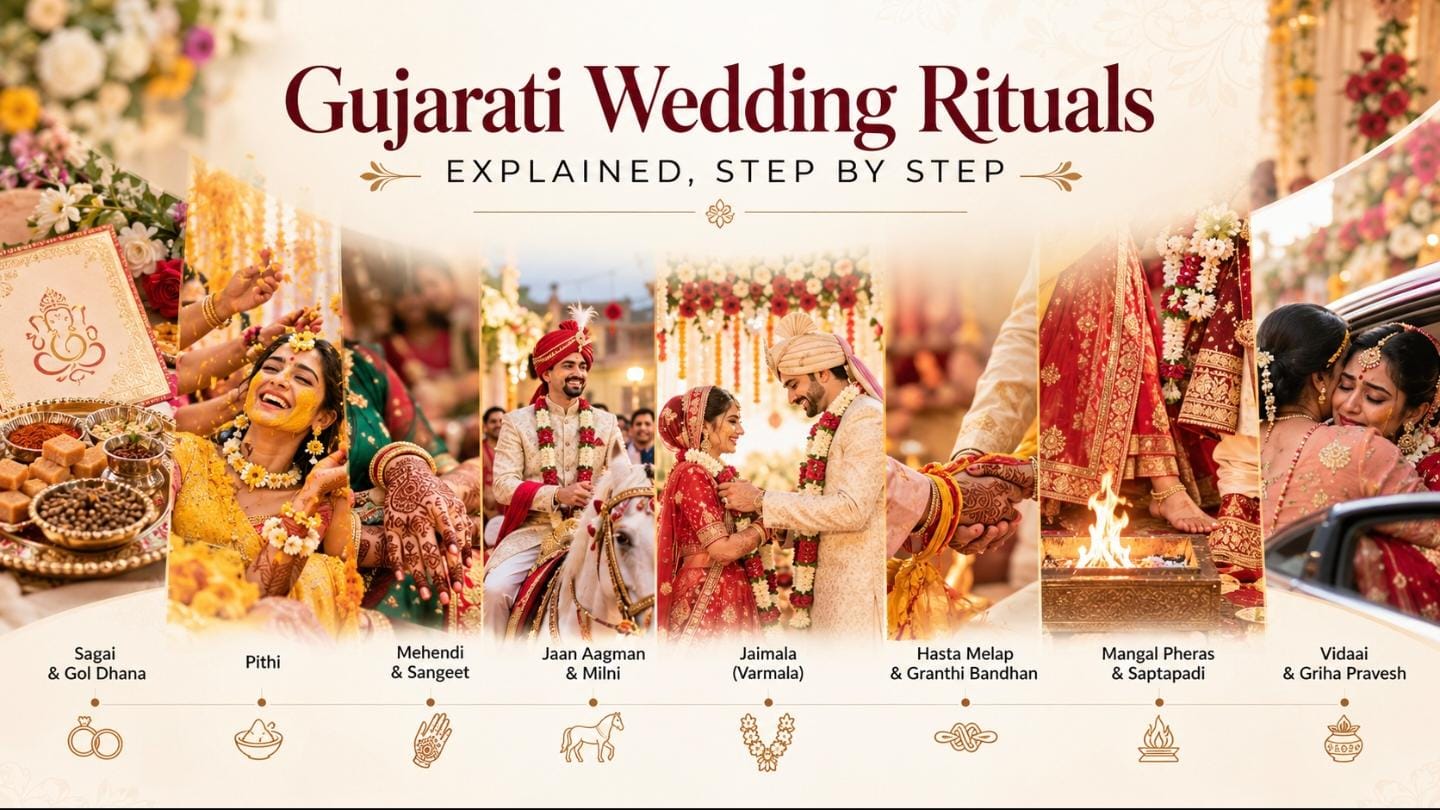
Sagai and Gol Dhana
The engagement. Traditionally, gol dhana (jaggery and coriander seeds) is shared to mark the formal agreement between the two families. The couple exchange rings, and in many families the bride receives a chandlo, a red mark of blessing applied on the forehead, along with gifts from the groom's family.
Kankotri (the Wedding Invitation)
The first invitation traditionally goes to Lord Ganesha, asking for his blessings, before it is sent to relatives and friends. Many families still deliver invitations in person, especially to elders.
Ganesh Sthapana and Grah Shanti
Days before the wedding, a puja invokes Ganesha to remove obstacles, and a Grah Shanti ritual seeks peace from the planetary influences. Both families usually perform these at home.
Mandap Muhurat
At an auspicious time, the pole of the wedding mandap is ceremonially installed. It marks the official start of the wedding festivities at home.
Pithi
Turmeric paste (pithi) is applied to the bride and groom at their respective homes. It is meant to bring a natural glow and to ward off the evil eye, and it is usually a joyful, noisy occasion with relatives singing and teasing the couple.
Mehendi, Sangeet and Garba
Henna designs for the bride, followed by music, dance and, of course, Garba and Dandiya. For many guests this is the most memorable evening of the wedding.
On the Wedding Day
Jaan Aagman and Milni
The groom arrives with his family (the jaan). The bride's family receives them with a warm welcome, and the milni follows, in which relatives from both sides meet and exchange greetings and gifts.
Jaimala (Varmala)
The couple exchange garlands, a symbol of acceptance and respect for one another. It is often a playful moment, with friends lifting the bride and groom.
Madhuparka and Kanyadaan
The groom is welcomed with a traditional offering, and the bride's parents then perform Kanyadaan, entrusting their daughter to the groom. It is often the most emotional moment of the ceremony.
Hasta Melap and Granthi Bandhan
The priest joins the couple's hands and ties a knot between the bride's garment and the groom's. The knot symbolises the lifelong bond between them.
Mangal Pheras and Saptapadi
The couple walk around the sacred fire, taking vows at each step. Gujarati weddings are known for the Mangal Pheras, with the bride and groom taking turns to lead as they circle the fire, followed by the seven steps (Saptapadi), each with a vow for their life together.
Sindoor and Mangalsutra
In many families the groom applies sindoor and ties the mangalsutra, marking the couple as married.
After the Wedding
Vidaai
The bride says farewell to her parents and childhood home. It is a tender, emotional moment, and a reminder of why weddings in Gujarat are really about two families coming together.
Ponkhvu
When the bride arrives at her new home, her mother-in-law welcomes her at the door with a traditional ponkhvu ritual, a gesture of warmth and blessing for her new life.
Griha Pravesh and Fun Games
The bride enters her new home, often by knocking over a pot of rice or kumkum. Light-hearted games between the couple follow, a lovely way for the two to ease into married life together.
Why These Rituals Still Matter
For many Gujarati families, especially NRI families living far from home, these ceremonies are a way of keeping a living connection with culture and community. They also give two families a structured, joyful way to get to know each other, which is where a lot of lasting relationships begin.
Common Questions
How long does a Gujarati wedding usually last? Anywhere from one to three days, depending on the family and how many of the optional ceremonies (such as Sangeet and Garba) are included.
Are all of these rituals compulsory? No. Core ceremonies such as the Pheras and Kanyadaan are central, but many others vary by family and community. Some modern couples shorten or combine events.
Do Jain and Patel weddings follow the same steps? The overall flow is similar, but specific rituals, mantras and customs can differ. Your priest or family elders are the best guide for your own community.
Looking for the Right Match First?
Understanding the traditions is one half of the journey. The other is finding a partner and a family you can trust. At Rishtadekhoo, a dedicated relationship manager personally guides your family, and every profile is verified before it is shared. Read about how to spot a fake matrimony profile, browse our FAQs, or book a free consultation.